2 min readLongevity & Biological Age
VO2max is the strongest mortality predictor we have. Here is why.
A landmark 2018 Cleveland Clinic study found the mortality gap between low-fit and elite-fit is larger than between smokers and non-smokers. VO2max is the metric behind it.
Part 4 of 23This article is part of the Longevity & Biological Age guideIn 2018, Mandsager and colleagues published a study of 122,007 patients in JAMA Network Open. The finding was stark: cardiorespiratory fitness, measured as VO2max, was inversely associated with all-cause mortality with no observed upper limit of benefit.
What is VO2max?
VO2max is the maximum volume of oxygen your body can use per minute, per kilogram of body weight, during intense exercise. It is the single best lab measure of aerobic fitness.
How big is the effect?
The mortality hazard difference between the low-fit and elite-fit groups exceeded the difference between smokers and non-smokers. Being unfit, in other words, carried a risk comparable to — or greater than — established disease states.
What counts as a good score
VO2max is measured in millilitres of oxygen per kilogram of bodyweight per minute, and it is always read against age and sex norms rather than as an absolute. A sedentary adult might sit in the low 30s, a recreationally fit one in the 40s, and a trained endurance athlete well above 55. The single most valuable move is escaping the bottom quartile for your age band, where the mortality risk is concentrated — every step up from there adds years of both lifespan and healthspan.
Why fitness predicts lifespan so powerfully
VO2max is not just a running number — it is an integrated measure of how well your heart, lungs, blood vessels and mitochondria work together. A high VO2max means a strong heart that moves more blood per beat, a dense capillary network, and muscle cells rich in mitochondria. Those same systems protect against heart disease, type 2 diabetes and cognitive decline, which is why a single fitness measure tracks so tightly with all-cause mortality: it is a proxy for the health of nearly every system that fails with age.
The good news: it is trainable
Unlike your age, VO2max responds to training at any point in life. A mix of zone-2 steady-state work to build the aerobic base and short, hard intervals spent near your maximum will raise it over weeks to months. Even moving from the bottom fitness quartile to the next one up carries a large mortality benefit — you do not need to become an athlete to capture most of the upside.
How to measure it without a lab
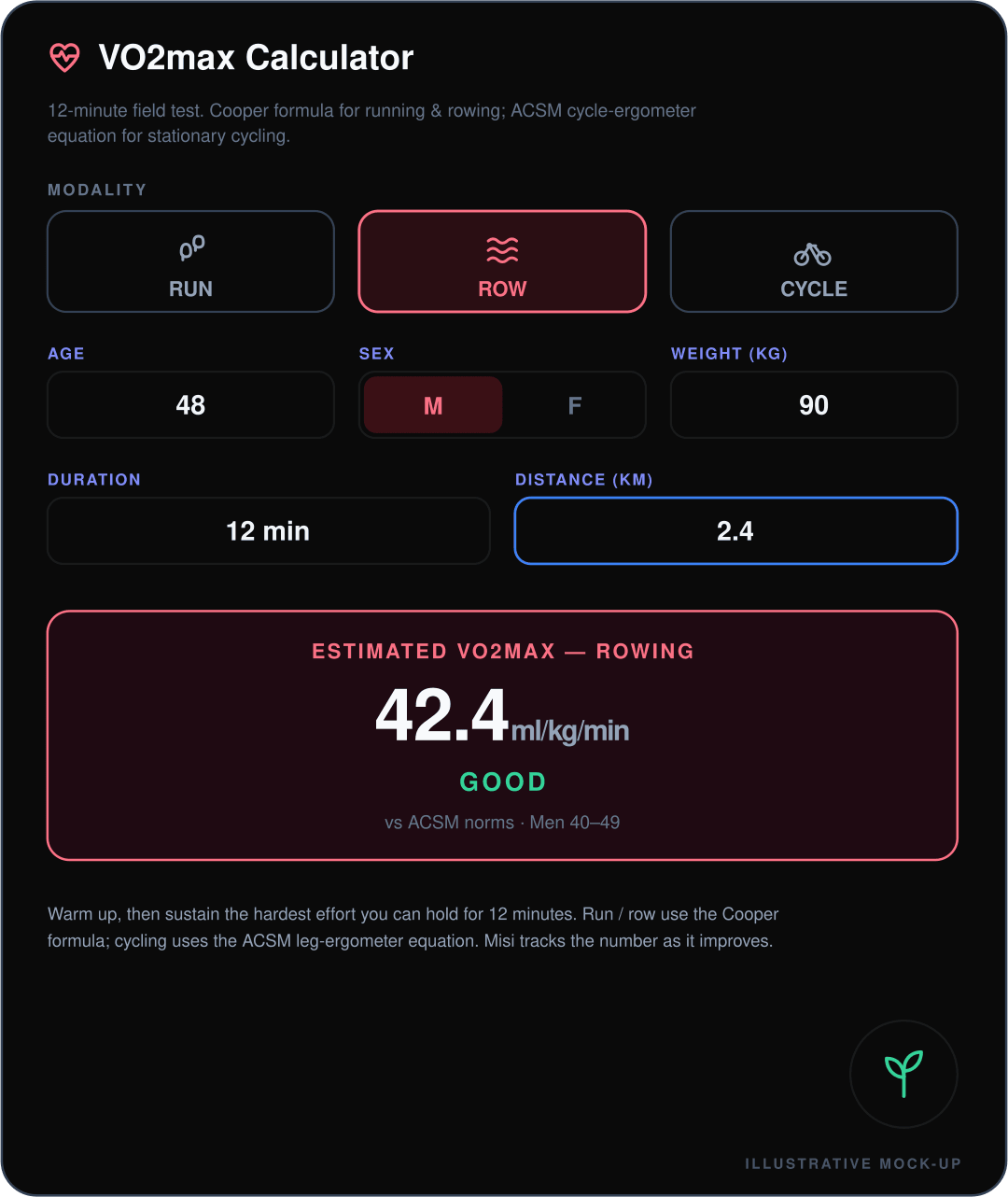
The Cooper 12-minute test estimates VO2max from the distance you cover in 12 minutes of maximum effort. Our free VO2max calculator turns that distance into your VO2max and a fitness rating against age and sex norms in seconds.
Ready to put this into practice?
Misi BioLabs turns your bloods into a meal plan, training block and AI coaching — in one place.
Start freeFree tools
- PhenoAge Calculator — Biological age from a standard blood panel (Levine 2018).
- Biological Age Calculator — How fast are you really ageing? Nine blood markers answer it — no quiz.
- VO2max Calculator — Cooper 12-minute test → VO2max + fitness age + mortality hazard.