2 min readLongevity & Biological Age
PhenoAge explained — what your bloods say about your real age
PhenoAge turns nine standard blood markers into a single number: how old your body is actually functioning. Here is how it works and how to lower it.
Part 1 of 23This article is part of the Longevity & Biological Age guideYour birth certificate measures one thing: how many times the Earth has gone round the sun since you were born. It says nothing about how well your cardiovascular system, immune function or metabolism are actually holding up. PhenoAge does.
What is PhenoAge?
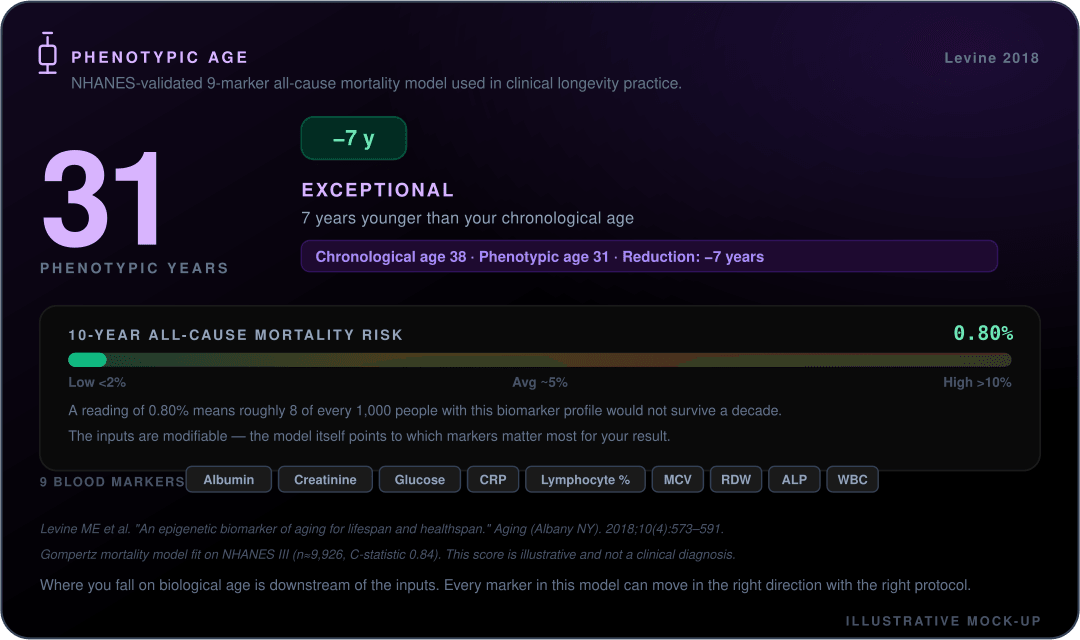
PhenoAge is a biological-age metric published by Dr Morgan Levine in 2018. It combines nine standard blood markers with your chronological age to estimate your phenotypic age — a number that, in the original cohort, predicted 10-year mortality more accurately than chronological age alone.
The nine markers
Albumin, creatinine, fasting glucose, C-reactive protein, lymphocyte percentage, mean corpuscular volume (MCV), red cell distribution width (RDW), alkaline phosphatase and white blood cell count. All nine appear on a standard CMP + CBC panel that costs very little.
Why it beats chronological age
Chronological age moves at the same rate for everyone: one year per year, no exceptions. PhenoAge does not. Because it is built from markers of inflammation, metabolic health, kidney and liver function and immune status, it captures how much wear your organ systems have actually accumulated. That is why, in Levine’s original NHANES analysis, PhenoAge outperformed chronological age at predicting both all-cause and cause-specific mortality — and why two people born the same year can be biologically a decade apart.
How to read your number
The number that matters is the gap between your PhenoAge and your real age. A PhenoAge below your chronological age means your biology is running younger than the calendar; above it means the reverse. A three-to-five-year reduction is meaningful; anything beyond that is exceptional. The direction of travel over repeated tests matters more than any single reading — a PhenoAge that is falling year on year is the goal.
How often to re-test
Because the most responsive markers — CRP and fasting glucose — can shift within weeks, retesting every three to six months is enough to see whether an intervention is working without chasing day-to-day noise. Standardise the conditions each time: a true fasting draw, no hard training the day before, and no acute illness, since an infection can spike inflammatory markers and temporarily inflate your score. Consistency in how you test is what turns a series of readings into a trustworthy trend.
Can you lower it?
Yes. Six of the nine markers are highly modifiable through diet, training, sleep and inflammation control — CRP and fasting glucose respond especially fast. Most people see measurable change within 8–12 weeks of consistent intervention.
Two 50-year-olds can have PhenoAges of 42 and 58 — and 10-year mortality risk that differs by an order of magnitude.
Calculate yours free with our PhenoAge calculator, then let Misi track it over time and rewrite your plan to drive it down.
Ready to put this into practice?
Misi BioLabs turns your bloods into a meal plan, training block and AI coaching — in one place.
Start freeFree tools
- PhenoAge Calculator — Biological age from a standard blood panel (Levine 2018).
- Biological Age Calculator — How fast are you really ageing? Nine blood markers answer it — no quiz.
- VO2max Calculator — Cooper 12-minute test → VO2max + fitness age + mortality hazard.