3 min readLongevity & Biological Age
The 4 numbers that predict your next 10 years better than your doctor’s checkup
A standard annual checkup misses the metrics that actually forecast your next decade. Here are the four numbers with the strongest predictive evidence — and, crucially, all four are trainable.
Part 3 of 23This article is part of the Longevity & Biological Age guideThe typical annual physical checks your blood pressure, weighs you, maybe runs a basic cholesterol panel, and sends you home. It is not useless — but it misses the handful of metrics that most powerfully forecast how your next decade will go. Four numbers, drawn from the strongest longevity evidence we have, do a better job. The best part: every one of them responds to training and nutrition, so this is a scoreboard you can change.
Number 1: VO2max (cardiorespiratory fitness)
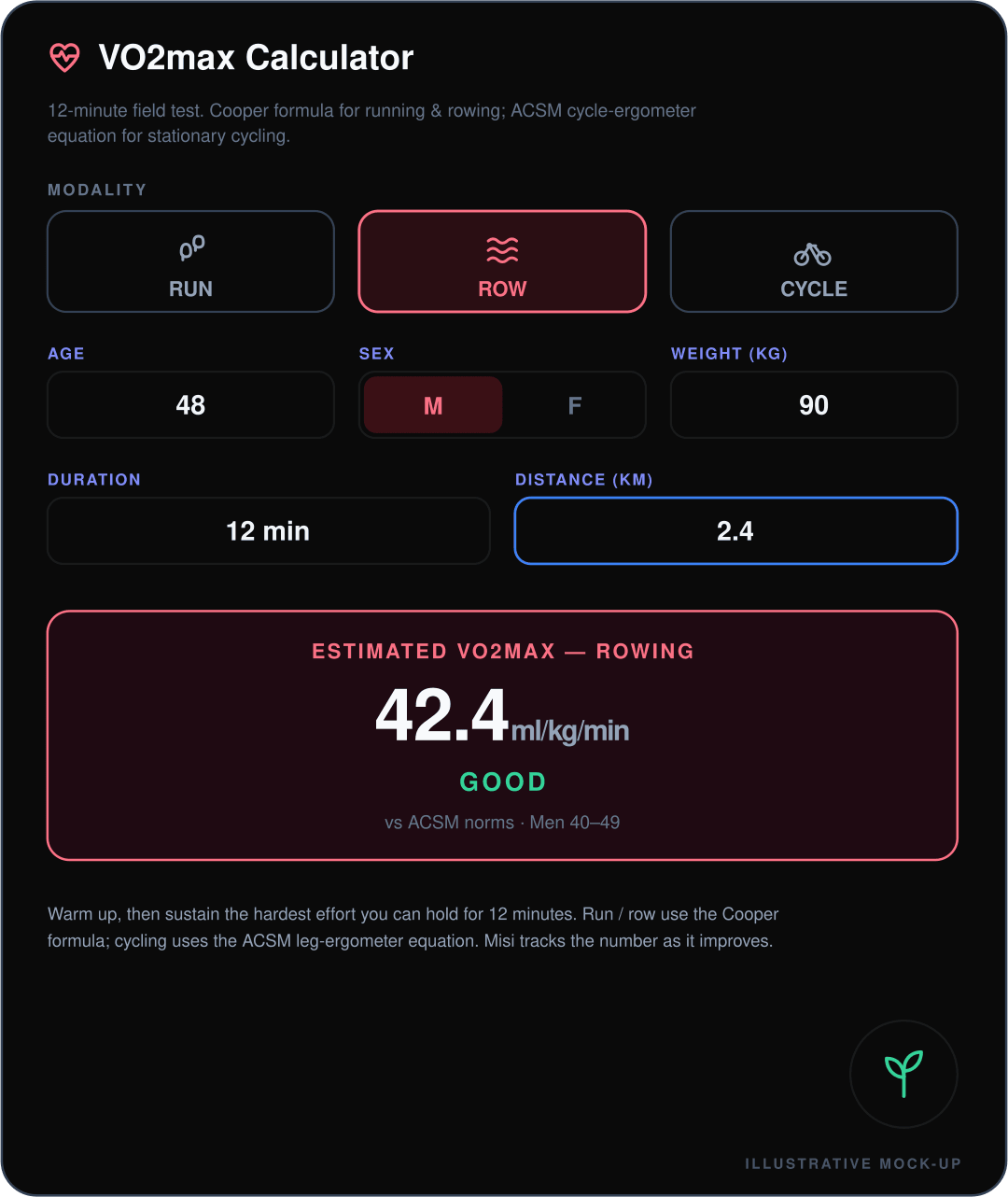
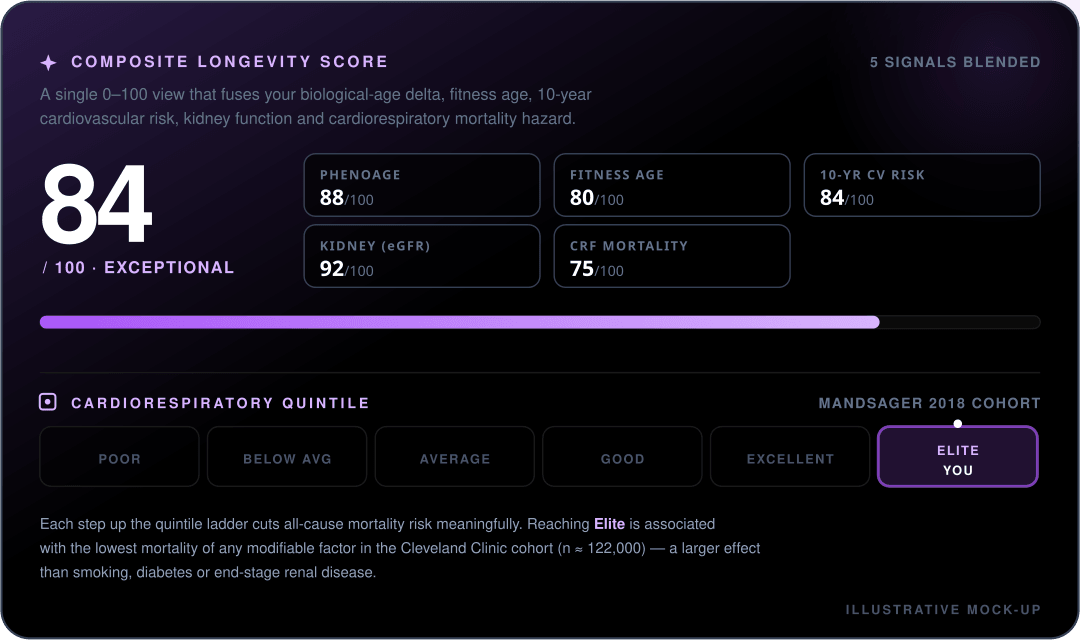
If you could track only one number, this would be it. VO2max — the maximum oxygen your body can use — is among the strongest modifiable predictors of all-cause mortality ever measured. In a study of over 120,000 people (Mandsager 2018, JAMA Network Open), moving from the low-fitness group to even below-average fitness was associated with roughly halving mortality risk, with no upper limit of benefit. Your doctor almost never measures it; you can estimate it from a simple field test and train it upward.
Number 2: muscular strength
Strength is the second pillar, and the evidence rivals fitness. In the PURE study (Leong 2015, Lancet), each 5 kg drop in grip strength predicted a 16% higher mortality risk — a stronger predictor than systolic blood pressure. Strength reflects the functional muscle that protects you against frailty, falls and metabolic disease. Whether you track it as grip or as your estimated one-rep-max in the big lifts, a strength trend pointing up is a longevity trend pointing up. (More in our piece on strength as a vital sign.)
Number 3: a metabolic marker (HbA1c or fasting insulin)
Metabolic dysfunction is the quiet engine behind much of modern chronic disease, and it starts years before a diabetes diagnosis. HbA1c (your three-month average glucose) or a fasting insulin / HOMA-IR reading catches insulin resistance early, while it is still easily reversible. A standard checkup often checks fasting glucose alone, which can look normal long after insulin resistance has set in — so this is a number worth asking for specifically.
Number 4: ApoB (or an inflammation marker)
For cardiovascular risk — still the leading cause of death — ApoB is the sharpest single number, counting the atherogenic particles that actually drive artery disease, and it often reveals risk that a "normal" LDL hides (see our ApoB explainer). If you want a fourth number focused on the ageing process itself rather than the heart, high-sensitivity CRP — a marker of chronic inflammation — is the alternative, since low-grade inflammation underlies much of how we age. Either one adds a dimension the standard checkup misses.
Why these four, together
No single number tells the whole story — someone can have excellent cholesterol and dangerously low fitness, or great lifts and hidden insulin resistance. Fitness, strength, metabolic health and cardiovascular/inflammatory risk cover the four systems that most determine your next decade, and a weakness in any one is worth knowing. Track all four and you have a genuine dashboard for healthspan, not the fragmentary snapshot a yearly physical provides.
How Misi keeps the scoreboard
Misi brings all four together in one place: it estimates VO2max from a field test, tracks your estimated one-rep-max as a strength trend, parses HbA1c, insulin, ApoB and CRP from your uploaded labs, and blends them into a composite longevity score with a forward trajectory. Instead of four numbers scattered across a gym log and a filed-away lab report, you get one evolving picture of how your next ten years are shaping up — and which lever to pull next.
Your annual checkup measures what is easy. These four numbers measure what matters — and every one of them will move if you train it.
This is general educational information, not medical advice. These metrics complement, not replace, medical care. Discuss your results with your doctor, and get clearance before starting vigorous exercise if you are new to it or have a medical condition.
Ready to put this into practice?
Misi BioLabs turns your bloods into a meal plan, training block and AI coaching — in one place.
Start freeFree tools
- PhenoAge Calculator — Biological age from a standard blood panel (Levine 2018).
- Biological Age Calculator — How fast are you really ageing? Nine blood markers answer it — no quiz.
- VO2max Calculator — Cooper 12-minute test → VO2max + fitness age + mortality hazard.