3 min readBlood Biomarkers
ApoB high, LDL normal: what now?
You measured ApoB, it came back high, but your LDL cholesterol looked fine — so what do you actually do about it? Here is the action plan that follows a high particle count.
Part 2 of 26This article is part of the Blood Biomarkers guideYou did the smart thing and measured ApoB rather than relying on standard cholesterol alone (if that sentence needs unpacking, start with our explainer on why ApoB beats LDL). The result: your ApoB is high even though your LDL cholesterol reads normal. That discordance means your true cardiovascular risk is higher than your lipid panel suggested — and now the question is not "what does it mean" but "what do I do." Here is the sequence.
Step 1: understand what the high number is telling you
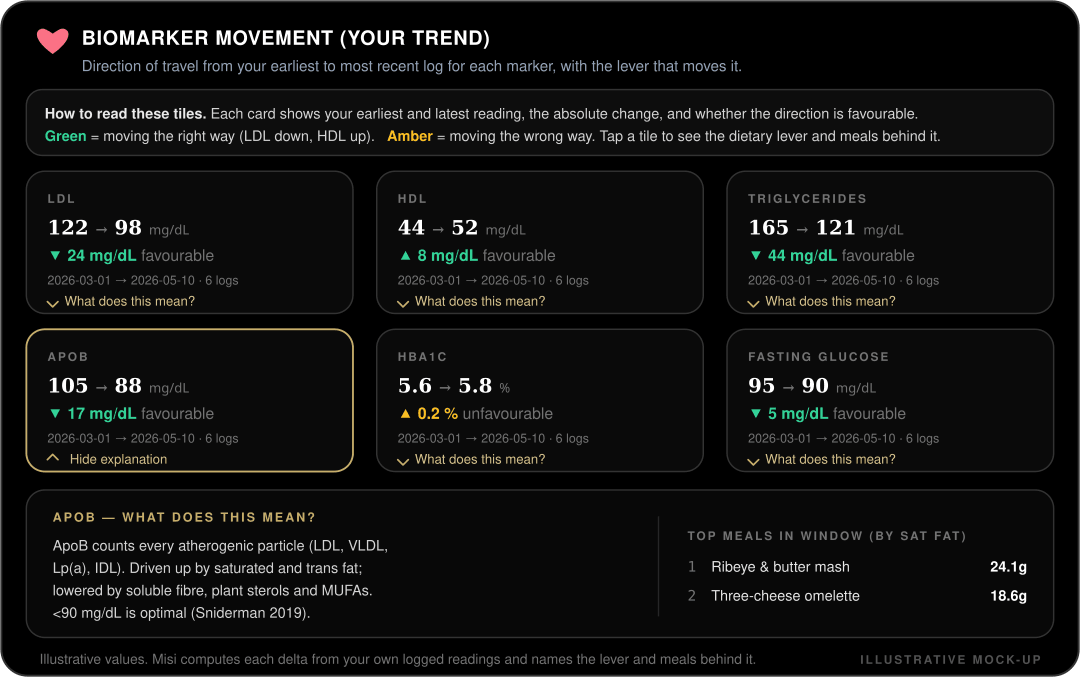
ApoB counts the atherogenic particles — LDL, VLDL, IDL and Lp(a) — that drive artery disease. A high ApoB with a normal LDL cholesterol usually means you carry many small, cholesterol-poor particles, a pattern strongly associated with insulin resistance, high triglycerides and metabolic syndrome. So the high ApoB is often not an isolated lipid problem; it is a flag pointing at your metabolic health as a whole. That reframing changes what you target.
Step 2: the dietary levers that lower particle number
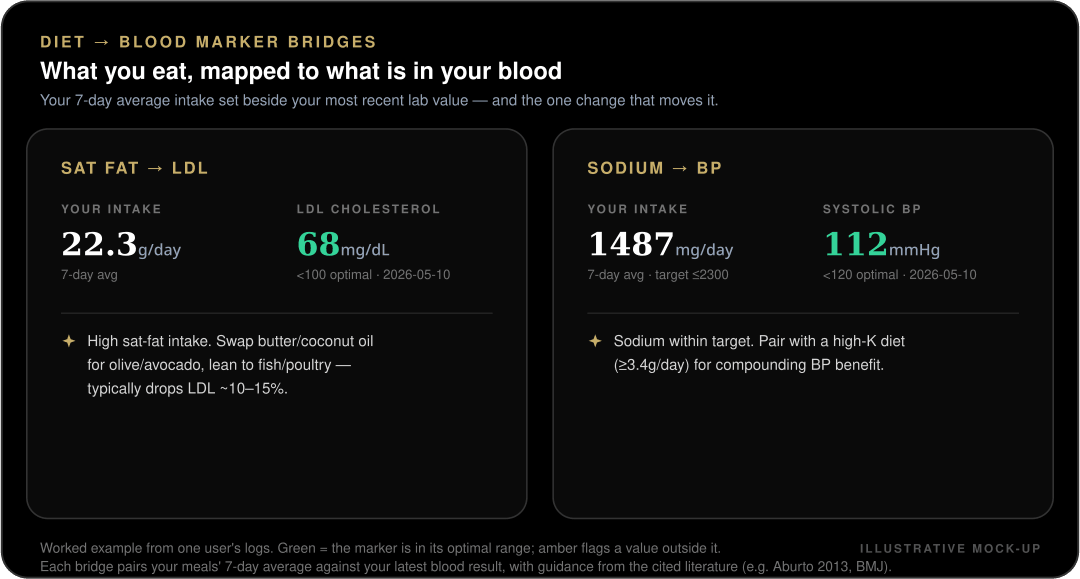
Two food levers do most of the work. First, reduce saturated and trans fat — swap butter, fatty processed meat and coconut oil for olive oil, avocado, nuts and leaner protein; this is the most direct dietary route to fewer ApoB particles, typically lowering them by 10 to 15%. Second, raise soluble fibre (oats, beans, lentils, psyllium), which binds bile acids and pulls particle number down further. Because your high ApoB likely travels with insulin resistance, cutting refined carbohydrate and added sugar attacks the metabolic root at the same time.
Step 3: fix the metabolic context
Because a high ApoB with normal LDL so often signals insulin resistance, the same moves that lower particle number also help the underlying picture: losing excess visceral fat, exercising regularly (both aerobic and resistance), and bringing down triglycerides. Treating the metabolic root rather than just the lipid line is what makes the improvement durable.
Step 4: know when diet is not enough
Diet and lifestyle can move ApoB meaningfully, but genetics set part of your baseline — some people, particularly those with familial patterns or elevated Lp(a), will not reach target on food alone. That is not a failure of effort; it is a signal to talk to your doctor about whether medication (such as a statin) is warranted. The point of measuring ApoB is to make that conversation precise, not to avoid it.
How Misi runs the sequence for you
Misi reads your ApoB from your panel and puts it in context — pairing it with your triglycerides, HOMA-IR, ASCVD risk and body-composition trend rather than reading it in isolation. It builds the bridge from saturated fat and soluble fibre to the particle count they drive, scales whole-food meals to hit those targets, and tracks the whole metabolic cluster over successive tests. The executive clinical report then packages it into one document you can take to your doctor when the medication question comes up.
A high ApoB with normal LDL is not a mystery — it is usually your metabolism waving a flag. Lower the saturated fat, raise the soluble fibre, fix the insulin resistance underneath, and re-measure.
This is general information, not medical advice. Decisions about ApoB targets and whether to start medication belong with your doctor, who can interpret the result against your full history, including Lp(a) and family history.
Ready to put this into practice?
Misi BioLabs turns your bloods into a meal plan, training block and AI coaching — in one place.
Start freeFree tools
- PhenoAge Calculator — Biological age from a standard blood panel (Levine 2018).
- Biological Age Calculator — How fast are you really ageing? Nine blood markers answer it — no quiz.
- VO2max Calculator — Cooper 12-minute test → VO2max + fitness age + mortality hazard.